Laravel's New Human-in-the-Loop AI Agent API
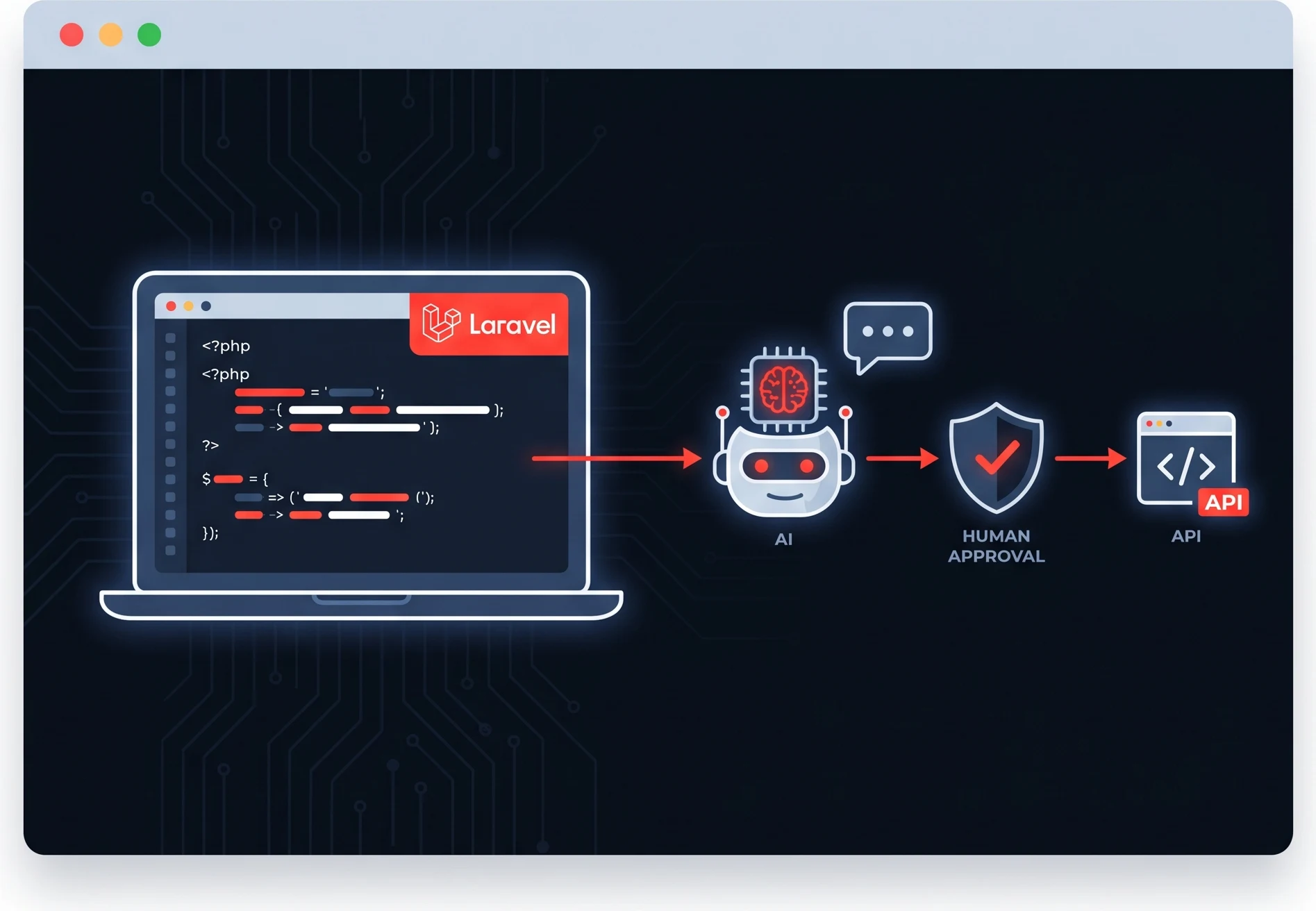
At Laracon US 2026, the Laravel team shipped a feature that says something about where AI development is heading: a Human-in-the-Loop (HITL) API for their AI SDK. Agents can now pause mid-execution and wait for a human to approve, deny, or modify a tool call before it runs — instead of firing off whatever action the model decided on.
Alongside it, Laravel introduced #[RepairToolCalls], an attribute that lets a model self-correct an unrecognized or malformed tool call rather than failing the entire agent run. Small feature, but it removes one of the most common reasons agentic workflows break in practice — a model calling a tool with the wrong shape of arguments.
Why a checkpoint, not more guardrails
Most "agentic" demos skip the part where something goes wrong. As long as an agent is answering questions, a bad output is just an annoying miss. The moment an agent starts taking actions — sending an email, charging a card, deleting a record, pushing to production — "mostly right" stops being an acceptable failure mode.
The usual response has been to bolt on approval logic by hand: custom middleware, a review table, a Slack bot that pings someone before a job runs. It works, but every team reinvents it slightly differently, and it's easy to leave a gap — one action path that skips the check because nobody remembered to wrap it.
Making the checkpoint a first-class part of the framework's AI SDK changes that. The approval step becomes something you declare on a tool, not something you have to remember to build around it.
What this looks like in practice
Conceptually, the flow is:
- The agent decides it wants to call a tool marked as requiring approval.
- Execution pauses. The pending call — tool name, arguments, and reasoning — is handed to whatever surface you use for review (an admin dashboard, a queue, a Slack message).
- A human approves, denies, or edits the arguments.
- The agent resumes with that decision, instead of the model's original, unchecked intent.
That's a meaningfully different default than most current agent frameworks, where "human in the loop" usually means the developer added their own polling loop and state machine around the model's tool calls.
Why it's a signal, not just a feature
Laravel isn't a framework known for chasing trends — it tends to formalize patterns after the ecosystem has already converged on them, not before. Seeing human approval treated as a first-class API, rather than something every team builds themselves, suggests the "agents need a checkpoint before irreversible actions" pattern has moved from best practice to expected default.
For teams currently shipping AI features with hand-rolled approval logic, this is worth watching — not necessarily to migrate immediately, but as a preview of what the baseline for "responsible agent" is going to look like across frameworks over the next year.
Open question for teams already doing this in production: are you using hardcoded approval rules, a review queue, or something more dynamic — risk-scored, maybe, so only certain actions or certain confidence levels trigger a human check? That's the part the framework can't decide for you.